
Sorting - a split second 'examination' deciding life or death...

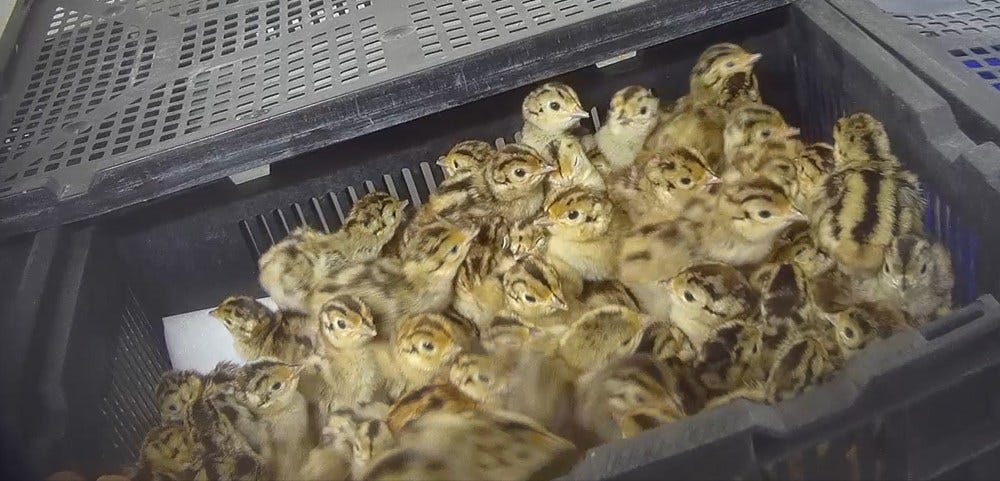
Over the past few months we have been publishing analysis of undercover footage obtained on so-called ‘game farms’ across England. We began by looking at the sheer scale of the shooting industry, then how adult birds (not every bird, but far too many) are sometimes treated, and the enormous numbers of eggs collected and washed - and in some cases dumped unlawfully in open-air trailers. In our last article we looked at very young chicks being ‘sexed’ and sorted. But we didn’t explain why…
The fact is that some chicks are pulled from the line because they are judged unfit to be worth the cost of rearing…
In our previous article we looked at very young chicks being ‘sorted’ in a noisy facility on a ‘game farm’. It was by necessity a condensed story. We couldn’t possibly have published all the footage we have - there is far too much of it for a Substack newsletter. If we had been able to do so, though, you would have seen the same thing that we did: every so often, one of the workers reaches down, picks up a chick, and drops it not into the trays heading onward toward the brooders, but into a different one - a tray already holding other discarded material.
This second tray is the sorting line’s endpoint for a chick that is unable to stand or is otherwise judged (at this very young age) not to meet the standard the farm wants for a bird it plans to sell. There is no vet on that line. There is no medical examination. There is a worker, moving at pace, making a snap decision about whether a days-old animal lives or dies based on nothing more than what can be seen in the second or two it takes to lift the bird up and look at it.
No attempt is made to treat an ‘unfit’ chick, or even to establish whether whatever is wrong is treatable. The young bird is simply removed, and his or her fate - as we’ll cover in the next article in this series - is to be macerated, ground up alongside the rest of the day’s waste.
‘Sorting’ - a judgement made in under two seconds
It’s worth looking at what this “sorting” actually entails, because the word perhaps makes it sound clinical, considered, even humane. It is not.
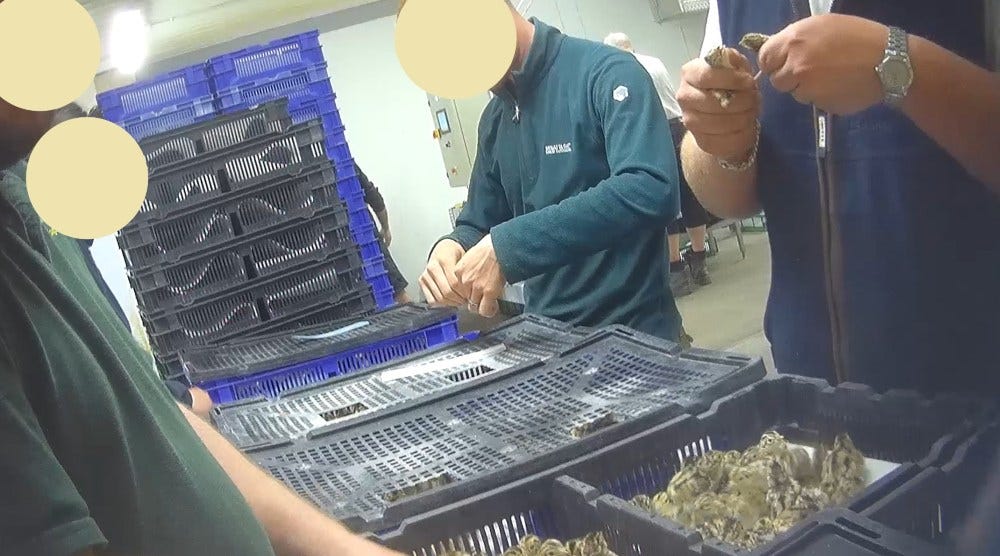
It is people rifling through crates of birds or standing by a moving conveyor belt hastily deciding whether a bird lives or dies.
There is no one here who can be absolutely certain which conditions are survivable. A chick that cannot stand may have splayed legs, a minor and often correctable condition. A chick with a slightly crossed beak might go on to feed and grow entirely normally with a little support. None of that is taken into consideration because the job is not about welfare; it is about keeping things moving.
A chick that doesn’t ‘look right’ isn’t a diagnostic puzzle to be thought about; it’s just something to be discarded, tossed away like a defective product on an assembly line.
That’s what happens when a live, sentient animal is fed into a system designed for speed and throughput. There is no room for sentiment, for a “let’s wait and see,” for anything resembling the care an animal in obvious difficulty might reasonably be owed.
The chick either passes inspection in the time it takes to glance at it, or it doesn’t.
Speed is everything, and if a chick gets stuck and injured on the line and no one seems to notice because they’re so intent on checking for ‘healthy’ birds, well, that’s just a bit of bad luck, isn’t it…
Units, not individuals
This is really the heart of it. An industrialised hatchery will not, and structurally cannot, treat each bird as an individual with its own chance of recovery or improvement. It treats every chick on that belt as a unit of production, one of tens of thousands moving through the building that day, valuable only if it will grow into a bird that can produce eggs or can be sold to be shot at.
A ‘unit’ that doesn’t meet the base specification isn’t nursed, isn’t assessed, isn’t given the benefit of the doubt. It’s removed from the batch, the same way a fruit-packing line removes bruised apples or misshapen carrots before the good stock is boxed for a supermarket. That comparison isn’t for dramatic effect, incidentally - it’s the logic the industry has built into its own handling systems.
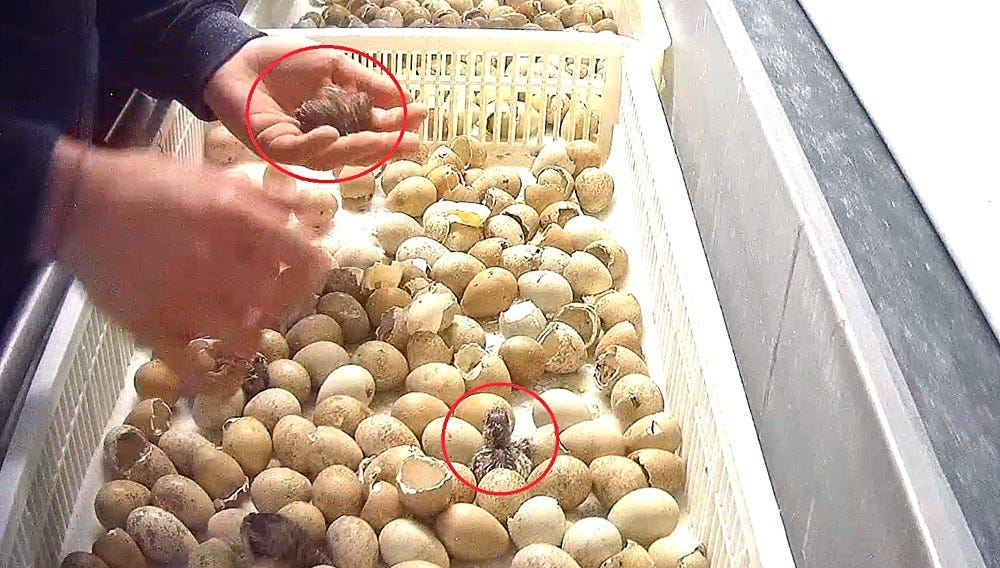
A visual check, a split-second judgement, a discard tray, is a sickening version of ‘quality control’. It is most certainly not any version of veterinary triage. And it is being applied to conscious animals capable of suffering.
That distinction should matter enormously. It appears not to matter at all to an industry designed to process living beings at pace.
What this tells us about the industry
This is what happens, structurally, when an industry breeds tens of millions of live animals a year for a single purpose - supplying birds to be shot for entertainment - and prices every one of those animals as expendable stock from the moment they hatch.
An industry that has already decided the great majority of the birds it breeds will be killed by paying guns within a few months of release has already decided that the individual bird doesn’t matter very much. It factors in a certain amount of loss from the outset. Discarding a “defective” chick, deciding with a brief look that it can’t be saved, is simply that logic applied slightly earlier in the timeline.
The industry constantly tells the public it cares about the welfare of the birds it rears, that shooting is compatible with, even reliant on, good husbandry. The tray sitting beside that sorting belt says otherwise.
When care is genuinely inconvenient to the pace of production, it is always the belt, not the bird, that wins.
Video and images recorded by our undercover investigator in 2025.
We are working to END BIRD SHOOTING. This suffering has to stop. Please share this article. Share our socials. Follow us for updates.
End Bird Shooting
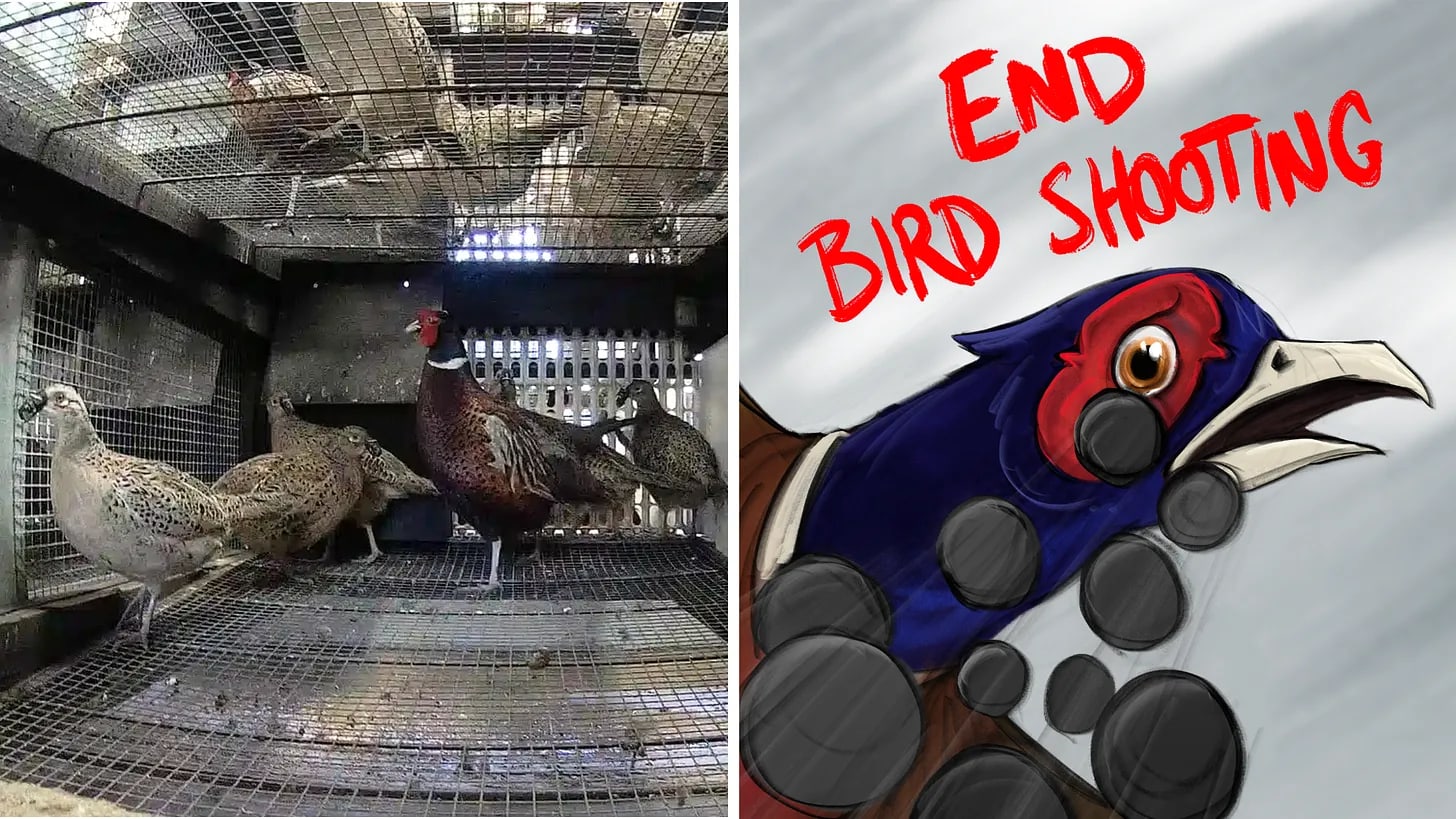
Over the coming months our campaign will look at the shooting industry at every level. We will highlight the suppliers — the farms, hatcheries, importers and breeders producing tens of millions of birds under conditions that would provoke public outcry if applied to any other animal. We will expose the providers — the estates and syndicates that take those factory-farmed birds and sell the experience of killing them as leisure. And we will look at the clients — the paying guns who are fully aware of the wildlife crime, the trapping of native predators, and the mass suffering involved, and who have decided that none of it is reason enough to stay away.
This industry survives because suppliers supply, providers provide, and clients pay. We intend to examine them all.
Join the movement. Become a Game Changer.
Months of investigation like the work detailed above. Hundreds of hours of footage obtained and more being gathered. Farms across the UK exposed.
We are at the beginning of something that we think will change everything.
But we can’t do it on our own. We are asking you to become a Game Changer. To help us fund investigations, take on more staff, to stand with us as we take this fight forward, week by week, piece by piece, until the public, the media and the politicians can no longer look away.
This is the beginning. Please be a part of it.