

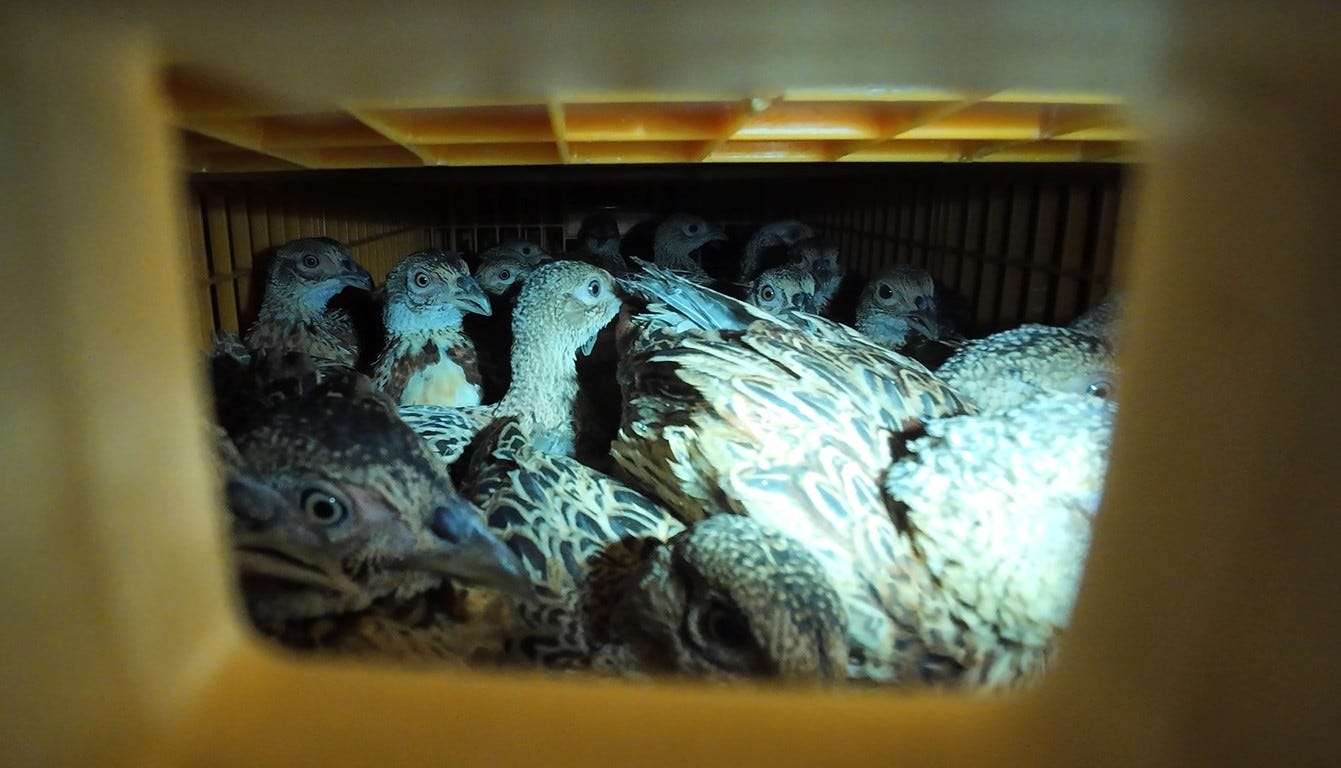
Last week, in Grabbed, Shoved, Crated, we showed you what “de-pop” looks like on a so-called game farm: hen pheasants pinned down, de-bitted, and shoved by force through too small a gap into orange plastic transport crates.
This week, the same industry, and the same crates, but a different farm and different birds. But once again the footage requires us to ask about welfare standards on the shooting industry’s factory farms?
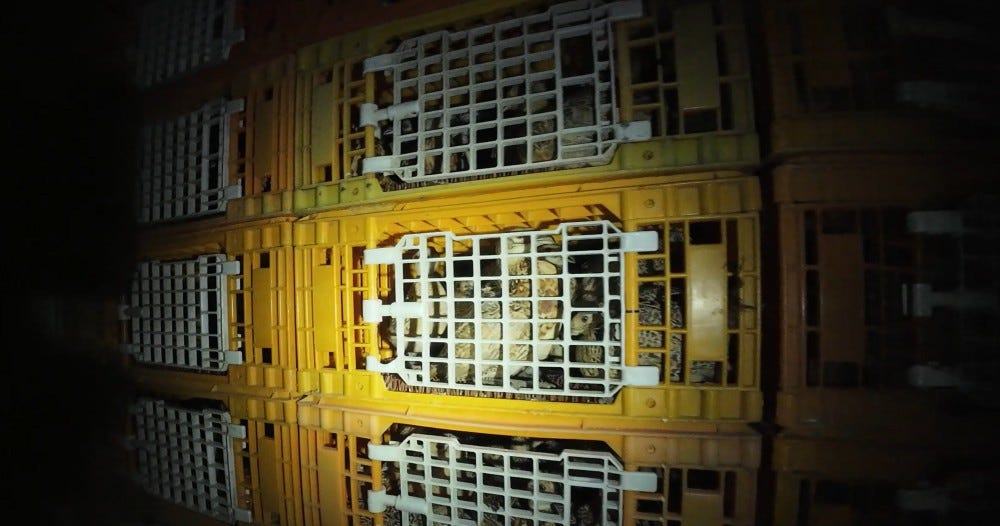
Our undercover investigation team filmed spent hen pheasants - birds that have already finished laying for the season and were, all the evidence suggests, being readied for transport to a shoot. The crating itself happened out of shot. When the team found them (at 02:00 in the morning), the birds were already crated and already loaded onto a trailer hooked up to a vehicle parked on the farm.
And that is where they stayed overnight. Crate after crate full of birds stacked high like tinned goods in a supermarket warehouse. No food. No water. Just birds huddled in the dark, not knowing where they were or what was planned for them, until someone came back the next morning to drive them away.
What we can and can’t say
We can’t say for certain whether the birds in last week’s article were left overnight without food or water as well: that footage was from a different farm entirely, and it ended with the lid closing over the birds.
We also can’t tell you that the crating on this farm followed the same process we wrote about last week, but we strongly suspect it looked much the same - the same grabbing, the same de-bitting, the same force to get a struggling bird through too small a gap - because practices like this spread across an industry: farms talk to each other, workers move between them, and the cheapest, fastest way of doing things becomes the norm everyone follows.
However, we don’t believe for a second that leaving crated birds overnight without food or water is some kind of an aberration confined to a single farm, on a single night.
It would be an extraordinary coincidence if the only place in the country where this happens is the one place our team happened to be that night.
A basic need, unmet
So what does the law say about this?
Under the Animal Welfare Act 2006, anyone responsible for an animal has a duty to take reasonable steps to ensure its needs are met. Among those needs are “a suitable diet” and access to water. These are not aspirational extras. They sit alongside protection from pain, injury and disease as the baseline the law says any animal is owed.
A hen pheasant crammed for the night into a crate with a dozen other birds, with no access to food or water, is not having her needs met. It doesn’t matter that pheasants can survive a night without eating. Simply providing enough to ‘survive’ rather than ensuring a bird’s needs are properly met is not the same thing, and it was never meant to be.
The industry’s own Code of Practice for the welfare of gamebirds reared for sporting purposes says handling and transport should be planned to minimise stress and should not compromise welfare. There is nothing in the Code of Practice that could plausibly justify a crate left standing overnight, with birds inside it who have had no access to water since they were caught.
But as we have noted many times in this series of articles, the Code is guidance, not law - non-compliance “shall not of itself render you liable to proceedings of any kind.” So a clear breach of the industry’s own standards - even if enforcement checks were carried out and someone in authority were to witness it - carries no automatic consequence.
Deformed beaks
There is something else we need to highlight: many of these birds had visibly deformed beaks, mandibles twisted or crossed rather than meeting straight (as the screenshot below shows).
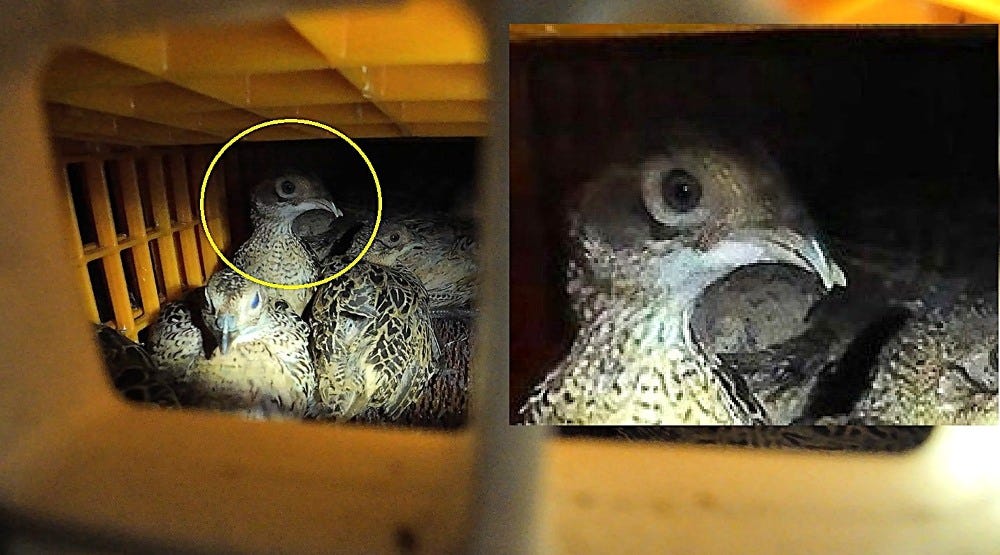
We can’t say for certain what caused it. Nutritional deficiencies - a lack of the minerals and vitamins young chicks need - can, in theory, soften bone structure and disrupt normal beak development. But the nutritional needs of farmed pheasant chicks are well understood by breeders, which makes this an unlikely explanation for deformities on this scale.
Far more likely is the use of ‘bits'. Bits are fitted to prevent feather-pecking, and their use across this industry is now routine: we’ve filmed them on farm after farm (see for example ‘Bits’: A Piece of Plastic Jammed Into a Young Face). It’s well documented that if a bit is left on too long, the growing beak doesn’t grow past it; instead it grows around it, permanently warping and distorting the beak as the bird matures.
Given how standard bitting has become, and how little scrutiny there seems to be over when bits are removed, it would hardly be surprising if that’s exactly what we’re looking at here.
Whatever the cause, it matters well beyond how these birds look. A captive pheasant can live with a malformed beak, because food is put in front of her in a shallow dish. Released into the wild, that same bird has to forage, peck and defend herself with a beak that no longer works properly - all because of a disability created on a ‘game farm’ that bred her to be shot at.
The defence we’re already expecting
When it comes to the overnight crating we can more or less write the industry’s response ourselves, because we’ve heard versions of it before. It will say this isn’t typical. It will say the investigators didn’t capture the whole picture - that birds may have been checked, or fed, or watered at some point the footage simply didn’t cover. It will say a single night is not cruelty, and that a prosecution built on this footage alone would likely go nowhere.
The industry may well be right about the chance of a prosecution: we’re not naïve about how high that bar is, or how reluctant enforcement bodies have historically been to act on undercover footage from a working farm. But we think it is vital that people outside this industry understand just how difficult it is - and understand just how the industry protects itself through weak legislation and lack of enforcement.
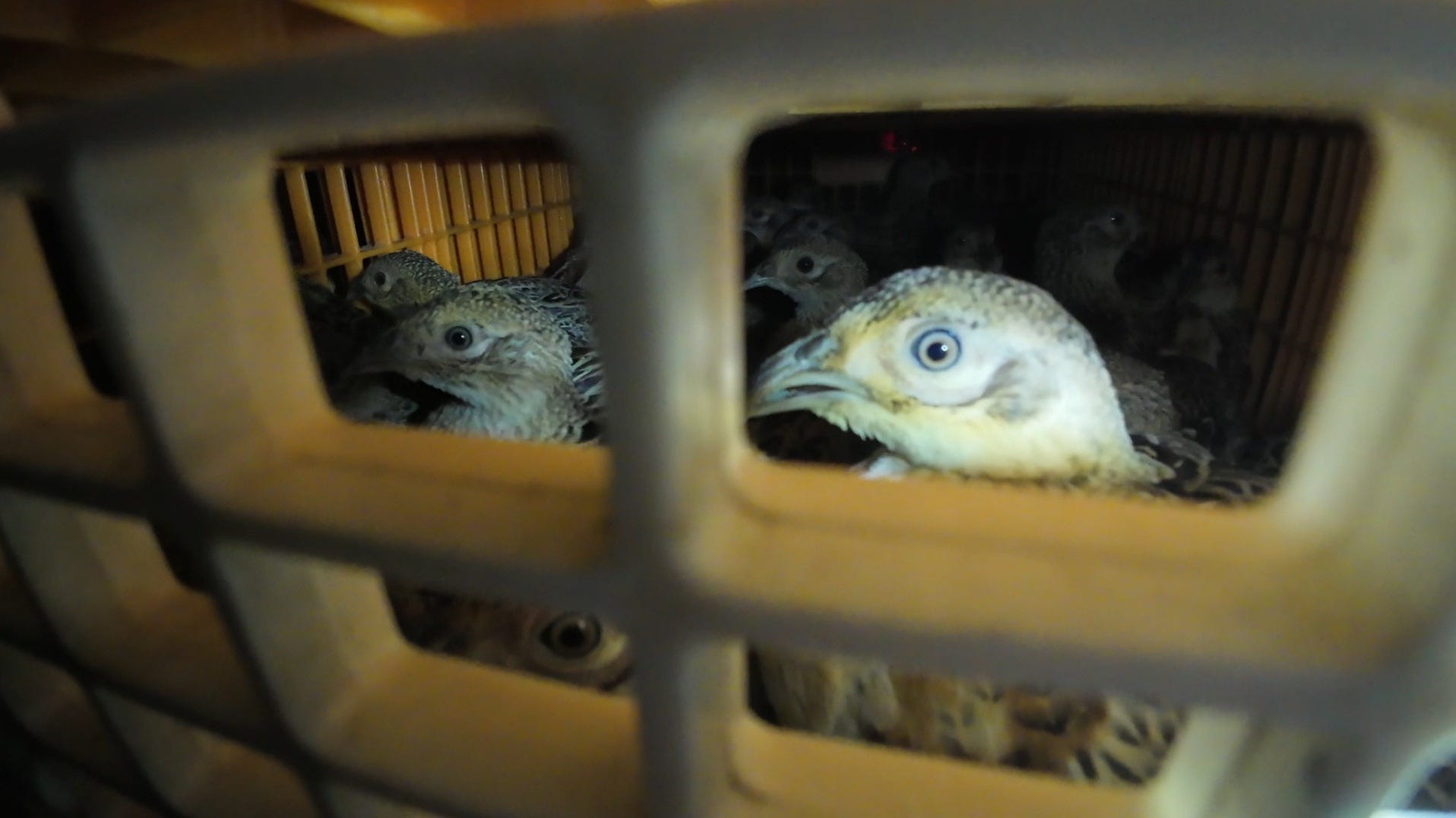
Whatever the legal arguments, we filmed birds crated and loaded, and left for hours in the dark without the two most basic things any animal needs: food and water.
So much for the ‘high welfare standards’ routinely parroted by the industry. To anyone who really cares about birds, that is inexcusable.
Why this matters now
Defra’s Call for Evidence on Gamebird Release, Shooting and Welfare during Rearing in England is open right now, and it asks directly how birds like these are handled and moved. We can not allow the industry to tell its usual story of “high standards” and “responsible husbandry” without challenge - especially while crates of pheasants sit overnight, unattended, with no food and no water.
We will be submitting this footage as part of our evidence. We think Defra - and the public - should see what “moved to a shoot” actually looks like, for the birds it happens to.
Footage and images recorded by an undercover investigative team in 2025.
We are working to END BIRD SHOOTING. This suffering has to stop. Please share this article. Share our socials. Follow us for updates.
Join the movement. Become a Game Changer.
We are at the beginning of something. Months of undercover work. Hundreds of hours of footage. Farms across the UK exposed. But we are only just getting started.
Many of you have already become a Game Changer, standing with us as we take this fight forward, week by week, piece by piece, until the public, the media and the politicians can no longer look away. We are extremely grateful
We are reaching a larger audience all the time, though, many of whom won’t know that Game Changers help us fund investigations, take on staff, and make us more effective. So we are going to repeat the call here - this is just the beginning, please be a part of it.
Makes me so sad at how these birds are treated. The people involved in this industry (what a horrific word to use in the circumstances) are sub-human.
Just signed up to a small monthly donation. Thank you for the work that you do.