

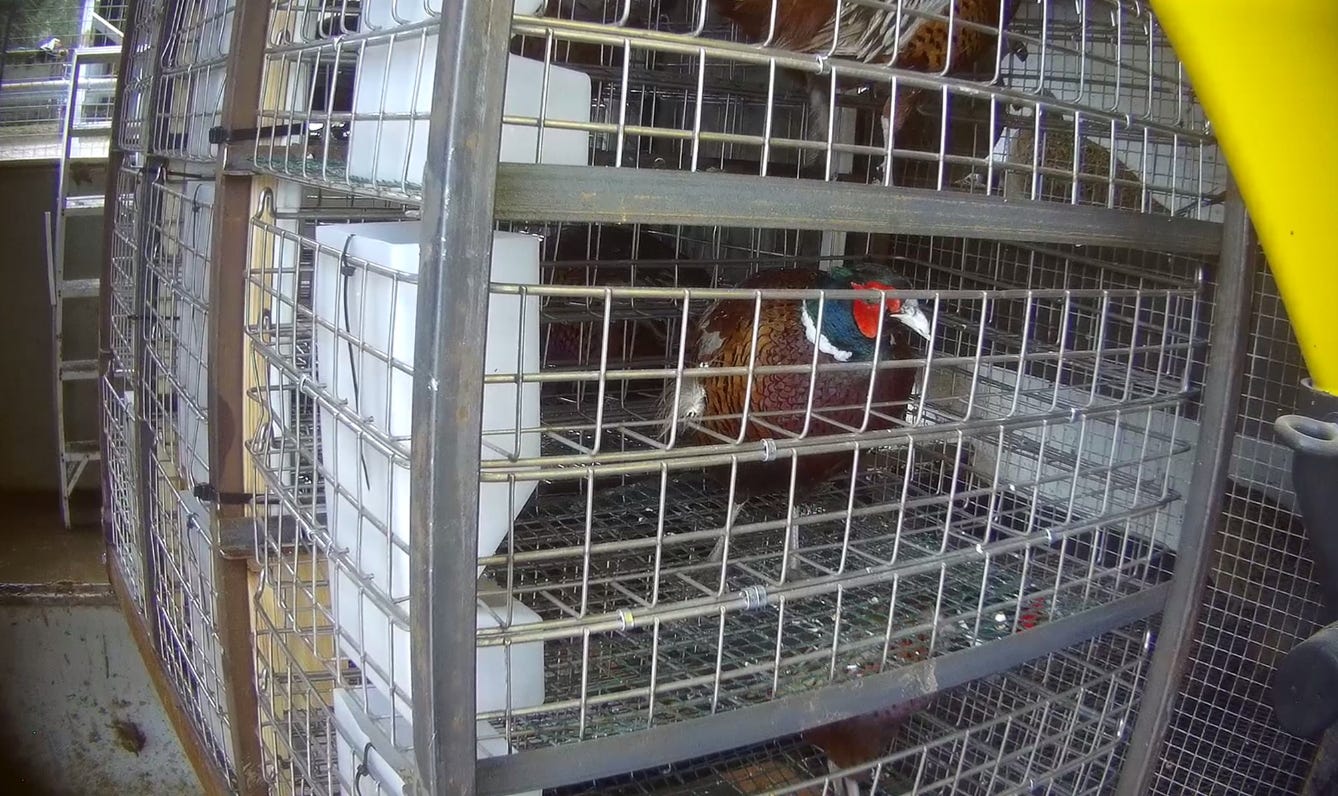
In our last article, we showed how a so-called ‘game farm’ had built its pen of ‘spare cocks’ directly in front of a shed full of caged hens - and how the workers seemed baffled that the males inside it kept fighting.
You might think the obvious answer would be to move the pen. Or to ask whether a system that keeps breeding males in reserve, within sight and earshot of females they can never reach, might itself be the problem and (as we would prefer) shut that system down immediately.
That isn’t what happened. There is less money to be made in doing things properly and profit drives decisions in the shooting industry. The farm made a different choice: to build cages specifically to house single cocks where they couldn’t attack each other.
The resulting small, barren cage - and the state of the male bird inside - should shock anyone who genuinely cares about animals.
“A drawer that the cock sits in”
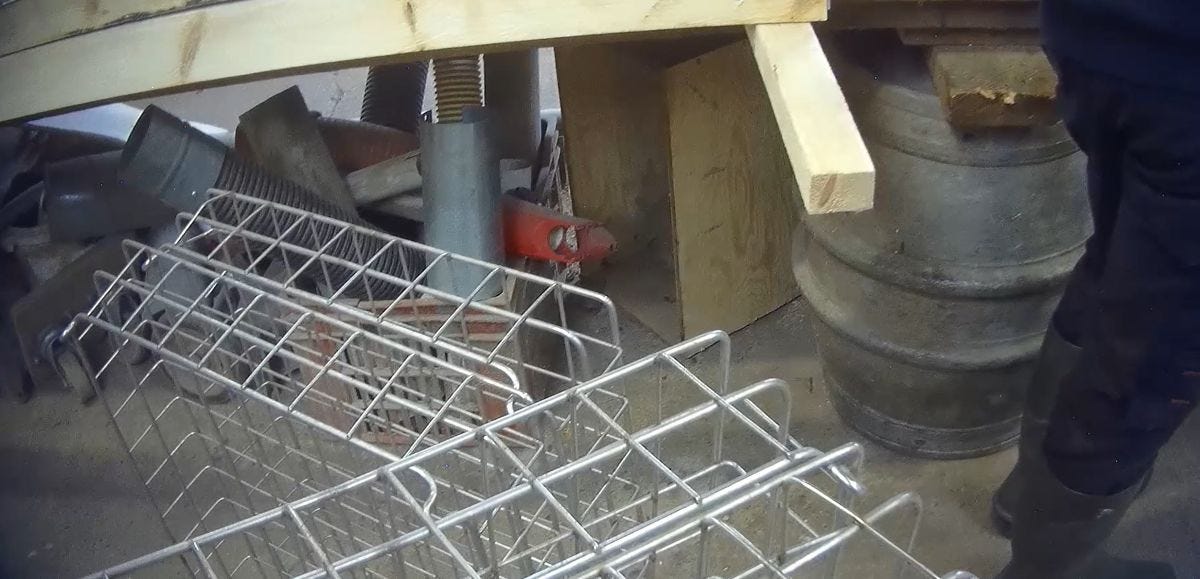
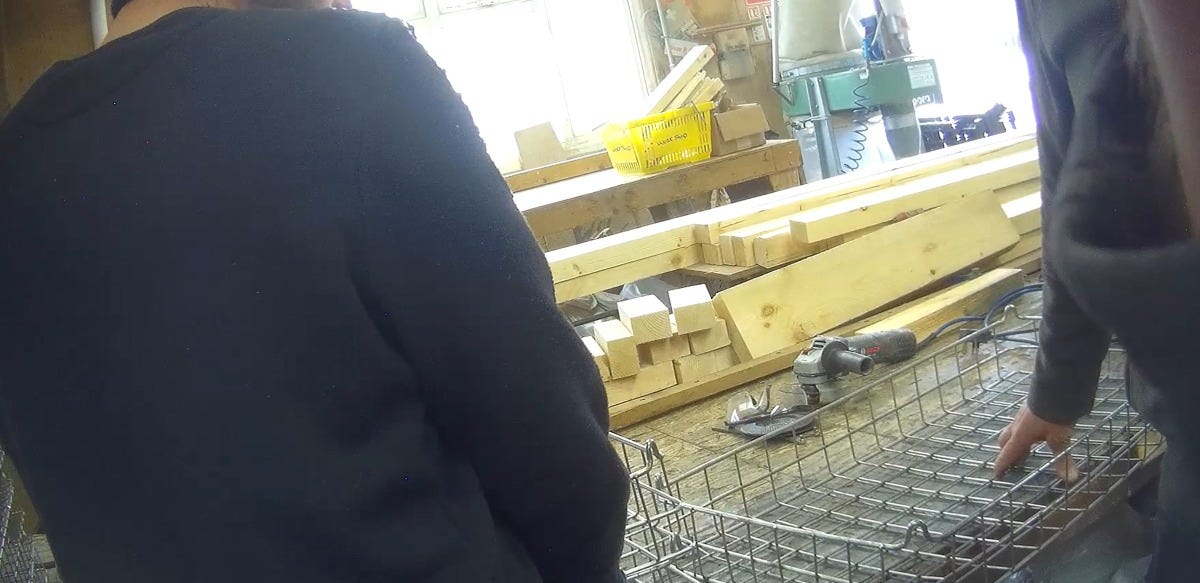
Our undercover investigator, employed on the farm for four weeks, recorded the owner explaining the plan. This is a direct quote:
“So we’re making frames to keep individual cocks in, okay? So this is going to be a drawer that the cock sits in on the end of your thing, right? So you can pull the drawer out, pull the feeder up, and easy to take the bird out so then you’ve got spare cocks all the time. So the good things about these is they’re stainless steel but we’ve got to do quite a bit of cutting and joining them together.”
A drawer. Not a pen, not even a cage, but a drawer - something you slide out, take from, and push back in. Every detail he is pleased about is solely designed around the convenience of the people handling the birds: easy to pull out, easy to feed, easy to remove a male when one is needed in a breeding cage. Stainless steel, so it lasts.
And this is clearly not a stopgap. In the owner’s own words, the point was to have “spare cocks all the time” - a standing reserve of males, each held alone until the farm has a use for him.
What is missing from that description is any thought at all about what life inside the drawer would be like for the bird who has to live in it.
Stacked cock upon cock
Our investigator’s footage shows the cages being ‘designed’ and built. And - a week later - the cages in use.
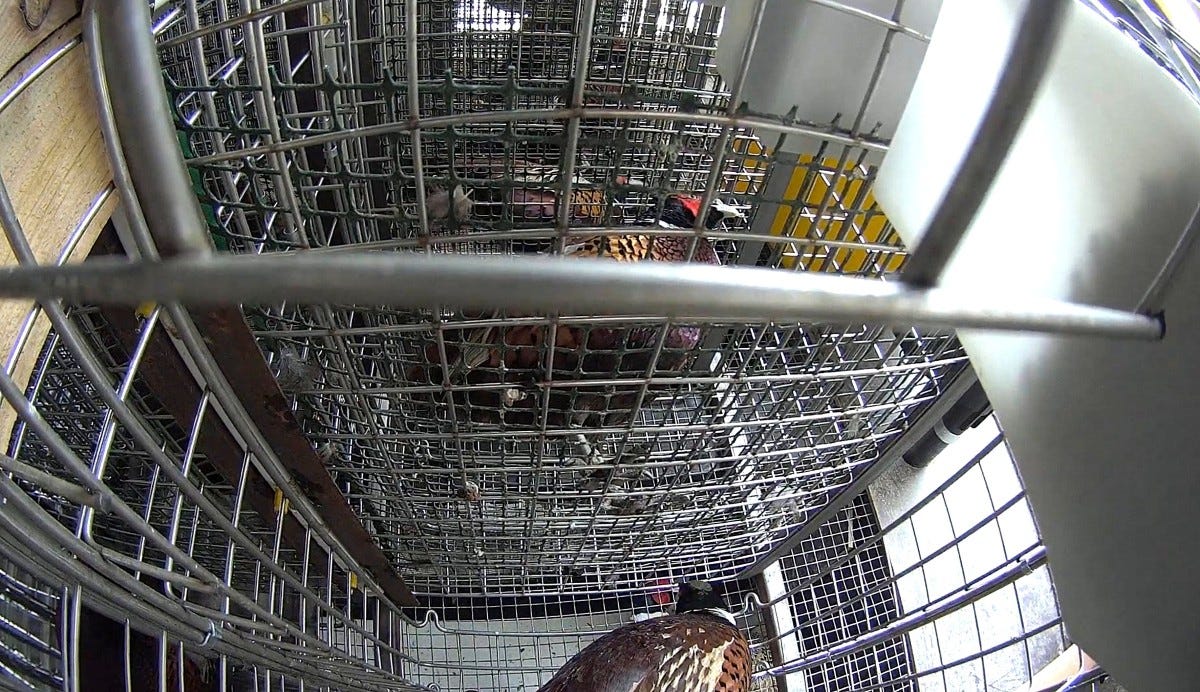
Each male is confined alone in a small wire box, with a plastic feeder fixed to one end. The floor is wire mesh. There is no perch, no cover, nothing to scratch at, no litter to dust-bathe in. A cock pheasant is a large bird with a long tail, and he has little more room than it takes to stand and turn. Many of the cocks in the video have lost parts of their tails.
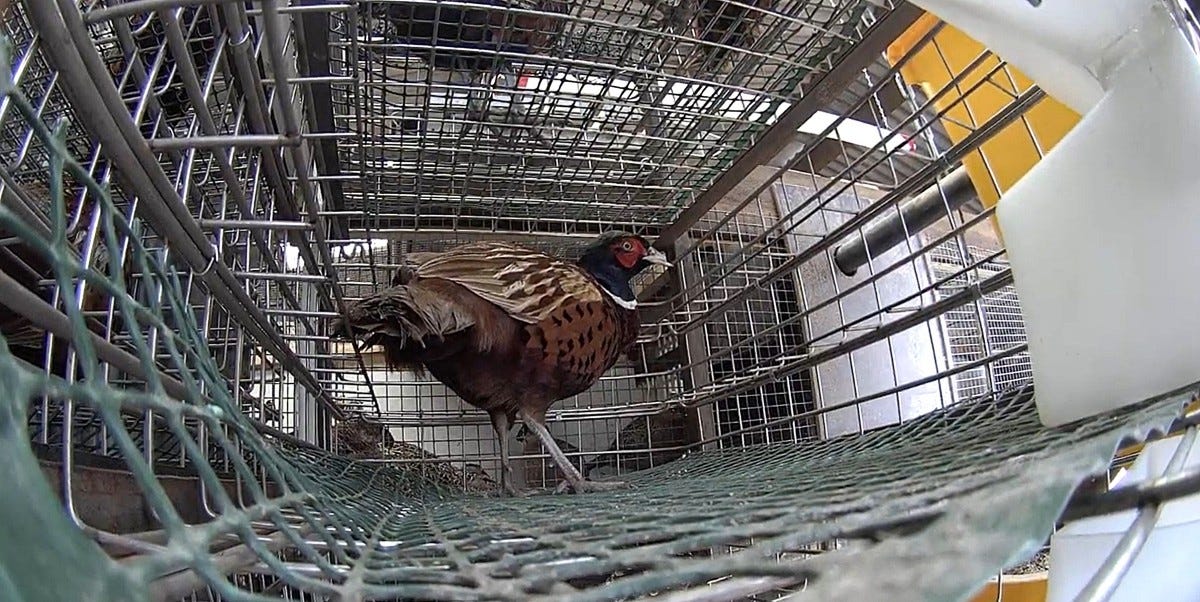
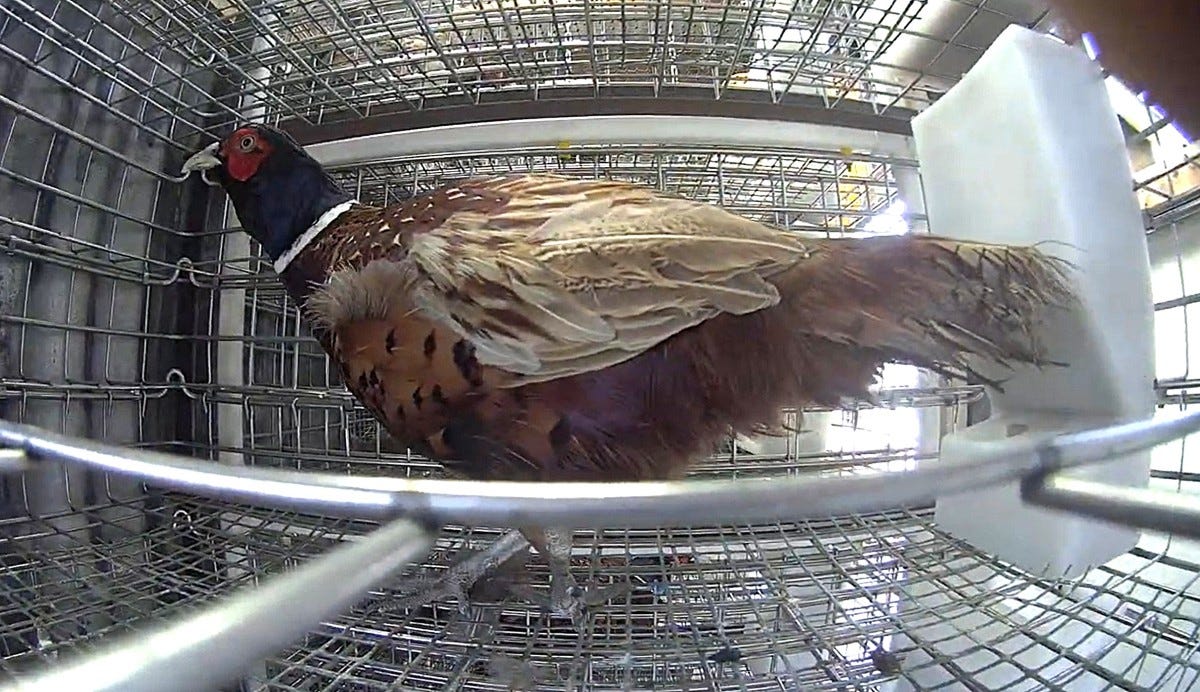
The boxes are stacked in a column, one male above another, several high. And that column stands right alongside the tiered ‘colony’ cages holding the hens.
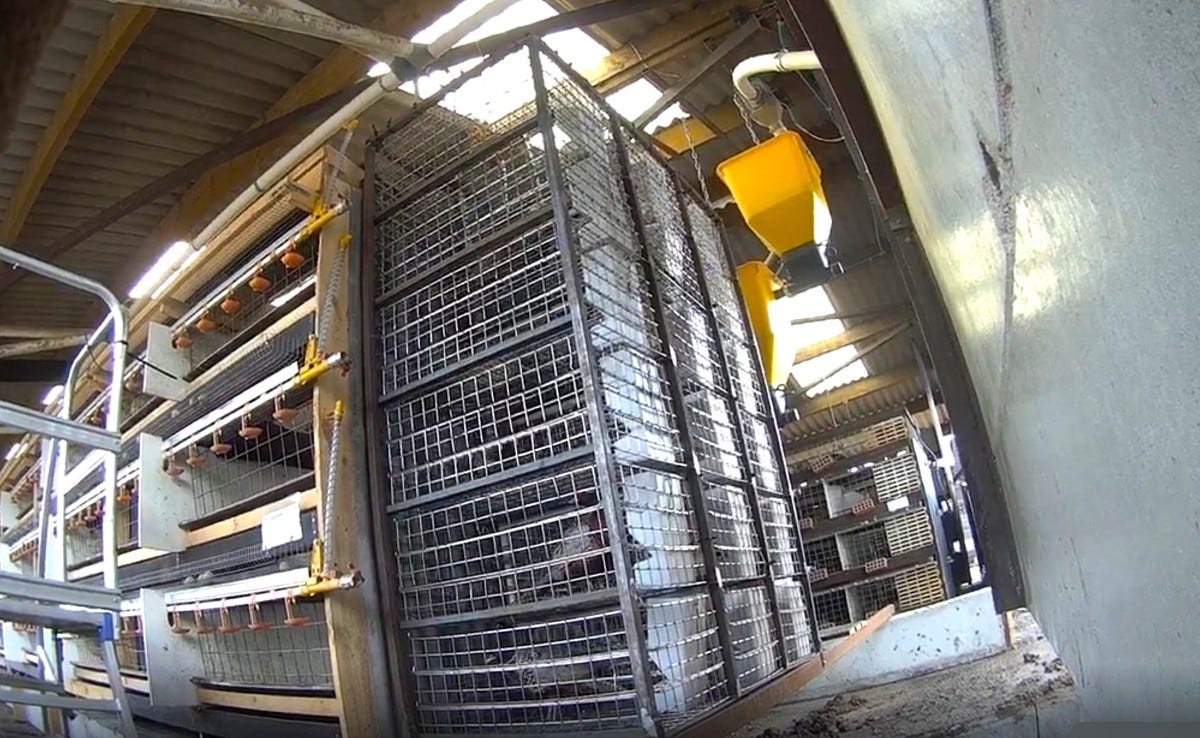
Read that again. The ‘farm’ had a pen of males made aggressive by the constant sight and sound of hens they couldn’t reach, and its solution was to take those males out of the pen - and put them even closer to the hens.
And because the cages are stacked on wire floors, everything a bird above excretes falls straight through onto the bird below. A screenshot captures the spray of droppings being released by a bird.
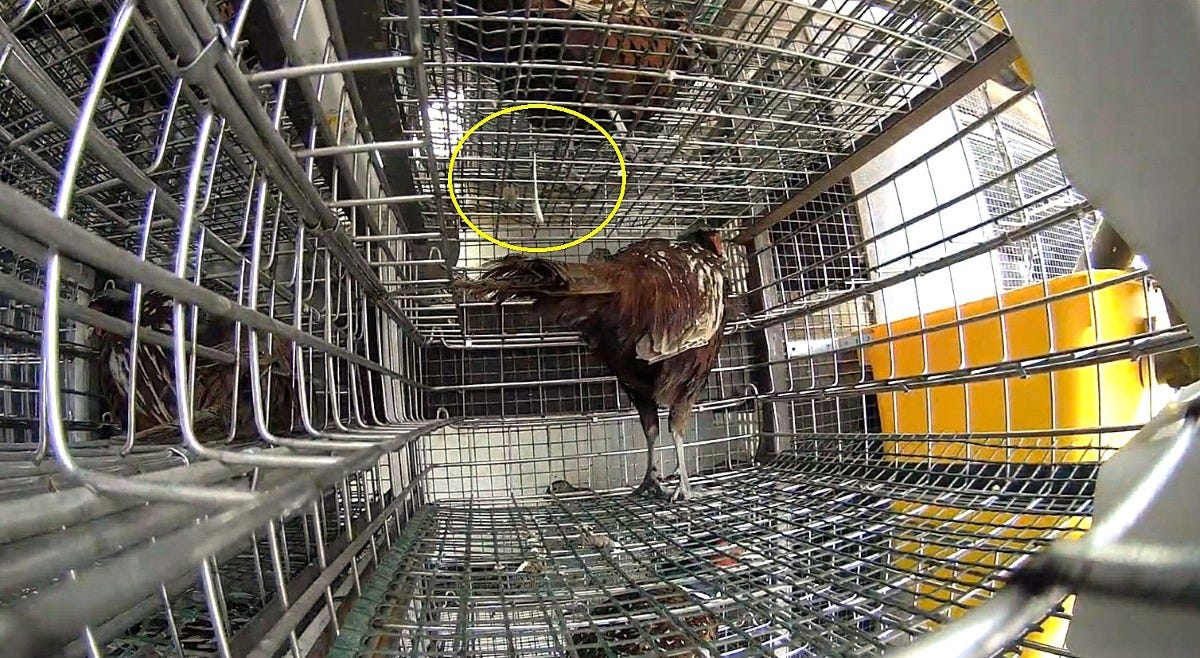
Over and over
The most telling footage is of a single cock in one of these boxes. He pushes at the mesh, over and over. A cock in the next cage is clearly pecking at him (who would guess that housing cock pheasants in cages next to each other wouldn’t solve that particular ‘problem’…).
Anyone who has watched a big cat or a bear in a poor zoo enclosure will recognise that relentless pushing at the mesh. It looks very much like what welfare scientists call a stereotypy: a repetitive behaviour, performed again and again, that serves no obvious purpose. It is widely recognised as a sign that an animal’s environment is failing them - that they are frustrated, unable to do what every instinct is telling them to do, and with no way of resolving it.
For a cock pheasant in the breeding season, those instincts are about space, territory and hens. He has none of the first two. The third is right there, through the wire, impossible to reach.
Fixing the fighting, not the cause
Pheasants are not solitary birds. Outside the breeding season they gather in groups, and in spring a wild cock lives alongside the hens he gathers and guards. What he never experiences is what this farm designed for him: isolation in a box, with females on view and permanently out of reach.
The farm will no doubt say they solved their problem. Cocks locked alone in drawers can’t fight each other. But the cause of the fighting was never the birds. It was the farm. Frustrated males confined in sight of hens they can never reach was the problem, and the farm’s answer was to make it worse: closer to the hens, in less space, with nothing at all left to do. They took away the last outlet these birds had. They can’t fight, they can’t flee, they can’t do anything except try to find a way out.
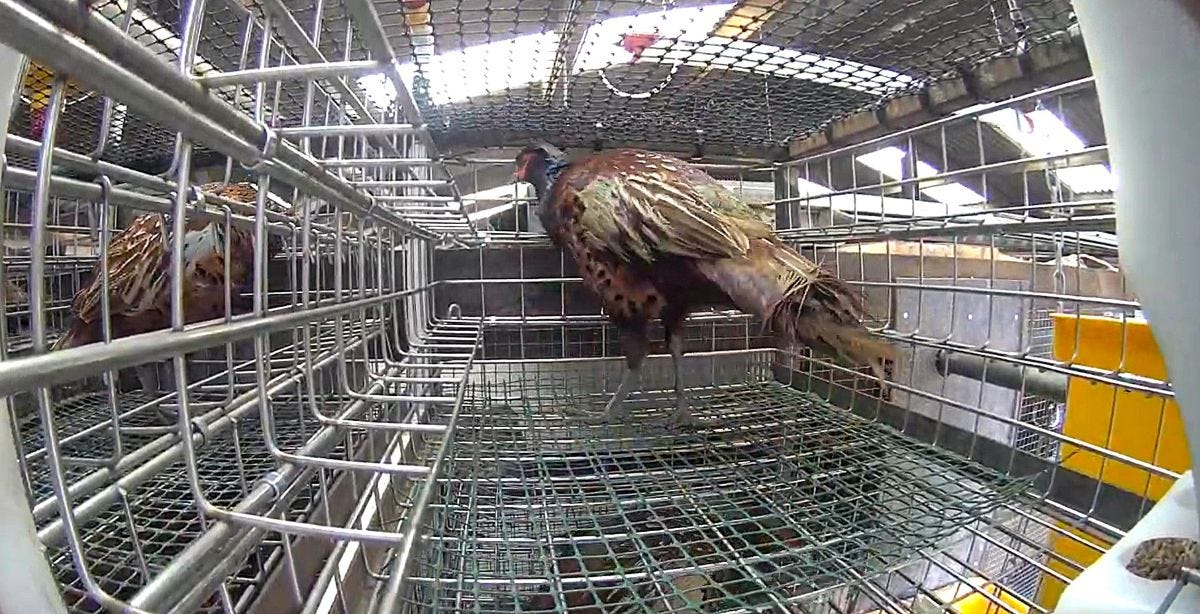
That isn’t a solution. It’s a punishment, handed out to birds for reacting exactly as anyone could have predicted to conditions the farm created.
We have watched hundreds of hours of footage from this investigation. This appalling supposed ‘response to male aggression’ stopped all of us in our tracks. Every one of us who saw it felt the same thing: fury.
What the law and the Code say
Is this lawful? We doubt it. Birds bred for shooting are protected animals under the Animal Welfare Act 2006. Section 9 of the Act places a duty on anyone responsible for an animal to meet their needs, and spells out what those needs include: a suitable environment, the ability to exhibit normal behaviour patterns, and any need to be housed with, or apart from, other animals.
That duty is backed by the statutory Code of Practice for the Welfare of Gamebirds Reared for Sporting Purposes. The Code says housing should be of sufficient size to ensure good health and welfare. It says barren raised cages for breeding pheasants should not be used, and that any system should be appropriately enriched. Failure to follow the Code can be used in support of a prosecution.
Look again at those cages. Raised wire boxes containing nothing but a bird and a feeder, stacked beneath another bird whose droppings fall through on to him. If that isn’t barren, we don’t know what the word means. And a cock repeatedly pushing at the mesh, in full view of hens he will never reach, is not a bird exhibiting normal behaviour. He is a bird being driven to distraction.
The Code sets no minimum cage sizes, and the industry has hidden behind that vagueness for years.
But nobody, reading ‘sufficient size’ and ‘appropriately enriched’, could honestly believe these drawers were what was meant.
Planned, measured, welded
Throughout this series we have shown cruelty built into the system of factory farming birds for the gun: hens worked until they die, chicks treated as items on a conveyor belt, eggs dumped by the trailer-load. Every time, the industry shrugs: ‘it just happens’.
Not this time. Nothing about this ‘just happened’.
Someone looked at a pen of distressed, fighting birds and decided the answer was to lock each of them up alone. Then they sat down and designed the cages. They chose stainless steel, so they would last. They measured, cut and joined the frames. They chose where to put them: right next to the hens. And then they explained it all, quite cheerfully, as a neat bit of engineering.
At every one of those steps, someone could have stopped and asked what this would mean for the birds. Nobody did. Or worse, somebody did, and decided it didn’t matter.
We are angry. We think you should be too. The shooting industry insists, over and over, that it cares about the birds it breeds. This is what that care looks like when no one outside the farm is watching: a living bird, filed away in a steel drawer, until he’s needed.
And never forget why. These cocks are kept as spares so that hens can go on laying, so that another generation of pheasants can be hatched, reared, released - and shot for ‘sport’.
We are making a full compilation of everything we found during our undercover investigation to submit to Defra’s Call for Evidence and this footage will feature.
We can’t see any scenario where what we’ve shown here could EVER be described as good welfare.
Video and images recorded by our undercover investigator in 2025.
We are working to END BIRD SHOOTING. This suffering has to stop. Please share this article. Share our socials. Follow us for updates.
Red-legged Partridge and Pheasant images come from our undercover investigation and were recorded in 2025.
This suffering has to stop. Please share this article. Share our socials. Follow us for updates.
Join the movement. Become a Game Changer.
We are at the beginning of something. Months of undercover work. Hundreds of hours of footage. Farms across the UK exposed. But we are only just getting started.
We want to END BIRD SHOOTING. Many of you have already become a Game Changer, standing with us as we take this fight forward, week by week, piece by piece, until the public, the media and the politicians can no longer look away. We are extremely grateful
We are reaching a larger audience all the time, though, many of whom won’t know that Game Changers help us fund investigations, take on staff, and make us more effective. So we are going to repeat the call here - please, join us and become a Game Changer today.