
General Licence restriction imposed on Scottish shooting estate for shooting of Golden Eagle
We don't imagine Raeshaw Estate will be quaking in its boots though...

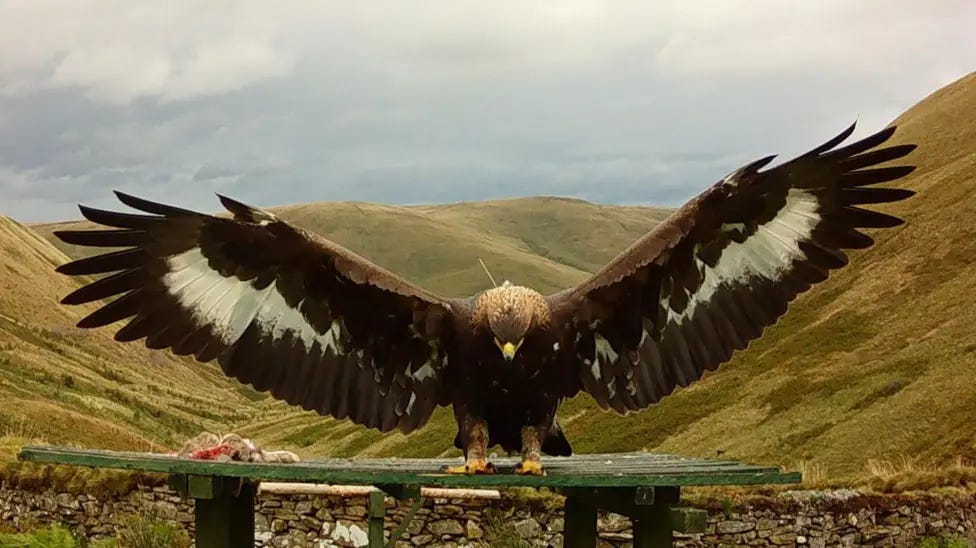
NatureScot (Scotland’s so-called ‘nature agency’) has handed a three-year General Licence restriction to Raeshaw Estate (and on neighbouring Watherston Wood, which is understood to be under separate management to Raeshaw), in relation to the shooting/killing of Merrick, a sat-tagged Golden Eagle, in October 2023.
Merrick was a young female Golden Eagle and part of the 2022 translocation summer releases organised by the South of Scotland Golden Eagle Project (SSGEP). The action comes just a day after an investigation was launched after another SSGEP Golden Eagle, ‘Hamlet’, was found with shotgun injuries in the Scottish Borders in January this year.
In a statement released on 10 February (which we will look at in more detail below), the agency said that:
“NatureScot has restricted the use of general licences at Raeshaw Estate and Watherston Wood in the Scottish Borders.
The decision was made based on evidence provided by Police Scotland of wildlife crime against birds.
This evidence included the sudden disappearance of a satellite-tagged golden eagle named Merrick in October 2023 as well as golden eagle blood, feathers and shotgun cartridge wadding recovered from the same location.
Chris Dailly, NatureScot’s Head of Licensing, said: “We have decided, in discussion with Police Scotland, to suspend the use of general licences on this land for three years until January 2029. The police have recorded Merrick’s disappearance as a crime and have provided robust evidence to NatureScot to support this.
“We are committed to using all the tools we have available to tackle wildlife crime. This measure will help to protect wild birds in the area, while still allowing necessary land management activities to take place.
“We believe this is a proportionate response to protect wild birds and prevent further wildlife crime. We will continue to work closely with Police Scotland and consider information they provide on cases which may warrant restricting general licences.”
Individual licences may still be applied for, but these will be subject to strict record-keeping and reporting requirements and will be closely monitored to ensure licence conditions are met.
In addition to this restriction, there are currently two other restrictions in place in Scotland: on Millden Estate in Angus and Lochindorb Estate in Highland.”
Raeshaw Estate
Raeshaw is a grouse moor and pheasant shoot just south of Edinburgh. Described in typically overblown terms by the William Powell Sporting Agency (who we suggest might want to look again at its copy) as “a stunning 9,000-acre mixed hill and low ground Estate…The Estate’s Pheasant and Partridge shoot is based on the lower slopes of the moor and includes the famous high bird drive ‘Craig’s’, which beautifully presents birds over the full line of guns that will challenge the very best…” this is the SECOND time the Estate has been ‘punished’ for raptor persecution.
As detailed by Raptor Persecution UK, back in 2015, Raeshaw was one of the first estates to receive a General Licence restriction. The restriction was based on evidence that wildlife crimes had been committed, but (as so often) there was “insufficient evidence” to prosecute an individual gamekeeper. The Estate applied for a judicial review, but the Court of Session upheld NatureScot’s procedures and ruled them lawful.
Commenting on the initial restriction in November that year, the ‘Wildlife Detective’ (the nom-de-plume of decorated and highly-respected former wildlife-crime officer and author Alan Stewart) wrote. “The website does not identify the estates to which the restrictions apply but Robbie Kernahan named them as Burnfoot Estate near Stirlingshire and Raeshaw Estate near Peebles. It was hardly a surprise as I could identify them in any case from the maps and from the many poisoned birds of prey found on each over the years.”
He went on to comment on the appeals made by the Estates in February 2016, writing: “I am not in the least surprised at this arrogance as I have witnessed this countless times during the years I was involved in policing wildlife crime.” He added that estates like Raeshaw were not only well known to the police and to the RSPB for wildlife crime, but also to other landowners and gamekeepers…so why do they and their organisations not stand up and be counted instead of offering up weak and unconvincing excuses?”
What, the industry circling the wagons and not admitting the problem? How unlike it…
Predictably, a statement from Raeshaw Estate on the latest restriction said it would again appeal, claiming that (despite the evidence referred to by NatureScot) Merrick’s killing had nothing to do with them and that no employee had been charged as a result of the police investigation.
What is a General Licence restriction?
NatureScot’s statement claims that the agency believes that a General Licence restriction “is a proportionate response to protect wild birds and prevent further wildlife crime.”
Really? Let’s think about that for a moment because it raises several important points.
A General Licence is an extraordinary ‘permission’ for (in this case) a shooting estate to ignore protections given to wild birds by the Wildlife & Countryside Act 1981 (WCA). The WCA is the legislation that says it is an offence to “intentionally kill, injure or take any wild bird”. It is the law that says you and I can’t simply go out and kill birds just because we feel like it…
…unless - and it is a massive ‘unless’ - you do feel like it and you operate a shoot or have a farm. In which case, you can kill birds using a General Licence (GL). GLs are wide-ranging, easy to get hold of, and – in reality – exist in name only. They don’t need to be applied for or downloaded. They are ‘legal permissions’ that act as exemptions to legislation, allowing specific activities that would otherwise be illegal.
Different General Licences cover different ‘reasons’ for killing different birds, but in effect they remove most of the protections given to many corvids. Estates kill thousands of crows every year to ‘protect’ profits from selling pheasants and grouse to shooters. Their profits are better protected than the nation’s wild birds.

Will it make any difference?
According to NatureScot, banning the estate from killing crows is going to stop wildlife crime. We don’t agree…
Firstly, the birds that estates are routinely and provably killing illegally are birds of prey. There are no General Licences for killing raptors (though the industry regularly applies for licences to kill Buzzards and between 2014 and 2019 Natural England issued around 70 licences, with specific cases in 2016 involving the permitted removal of up to 10-26 birds across a few applications). How telling an estate that they can’t kill Magpies is supposed to stoip them illegally killing Golden Eagles or Hen Harriers has never been concincingly explained.
Yes, when an estate is under restriction, they must report to NatureScot, enabling compliance checks, such as unannounced visits, to ensure that traps are not being used illegally to target raptors - but there are just over 800 NatureScot staff (across all roles) and even they admit that due to resources, this monitoring important sites like SSSis, which can range from basic to detailed, typically occurs only once every 6 to 24 years!
Secondly, while a restriction is supposed to be a punishment, etates with General Licence restrictions can apply for what is known as Individual Licences. While these are not quite the free-for-all licences that estates normally take advantage of, they do much the same thing. They give permission to kill wild birds. The only difference is that they must be applied for on a case-by-case basis through NatureScot (who are subject to the same staff limitations and work burdens we’ve already mentioned) and are subject to strict monitoring, including record-keeping and reporting requirements.
Almost inevitably estates have been found abusing the licence system. In fact, as was reported back in 2017 Raeshaw Estate itself abused Individual Licences it was issued WHILE it was under a previous General Licence restriction! As Scottish Natural Heritage (now NatureScot) itself reported “SNH imposed a general licence restriction on Raeshaw Estates in 2015 on the basis of clear evidence provided by Police Scotland that wildlife crimes had been committed on the estate…During a compliance check this month [two years later], SNH staff found multiple instances of breaches of conditions of an individual licence that had been granted to cover essential management activities on the estate. These breaches may also constitute offences under the Wildlife and Countryside Act, so SNH has reported the details to Police Scotland.”
A third point is that there is supposed to be a ‘reputational damage’ with the restriction of General Licences. This is presumably meant to have some sort of a potential financial impact on shooting estates.
Come off it. Raeshaw has had its GL taken away once already. It has been found breaking the terms of Individual Licences. It sits in a known raptor hot spot. Yet, none of that is mentioned by the lobbyists and advertisers promoting it. And why would they - shooting’s complicit (‘or wilfully blind’) clientele have never appeared bothered about whether their hosts are committing wildlife crime or not. As long as they get to shoot birds for ‘sport’ all else is just background noise. Despite the evidence and the ‘restriction’ Raeshaw will do what estates always do: deny, deflect, and carry on regardless. It will shrug, make a pretence about complaining about how unfair it all is, and get on with readying the shoots for the autumn - just as it has done every year since Merrick ‘disappeared’ in 2023…
If you really want to protect birds…
It is striking that the (ahem) onerous conditions of having to use Individual rather than General Licences includes more robust record-keeping. It’s always been scandalous in our opinion that under General Licences there are no mandatory reporting requirements for Estates to report the number of birds killed, eggs destroyed, or nests destroyed. To quote GL01, 02, and 03 “There are no reporting requirements unless using meat-based baits”.
NatureScot claims that one intention of withdrawing General Licences is to protect wild birds, and one of the conditions of using Individual Licences is to force estates into better record-keeping.
To us that is absurd. General Licences implicitly say that the shooting industry has a right to kill birds that the State correctly withdrew from everybody else decades ago. In our opinion, there should be NO presumption that shooting estates somehow deserve to kill wild birds at all. The Wildlife & Countryside Act should not be so easily sidestepped. The lives of wild birds shoudn’t be given away like free sweets at a hotel reception desk.
General Licences only exist because shooting wants (according to an online summary) “to be able to manage low-risk, common, or high-conflict situations efficiently without requiring individual, case-by-case applications.” In other words they want to kill a LOT of birds WHENEVER they want without having to go through the irritation of having to apply for a licence every time. Killing wild birds should be difficult and require a clear line of thought every single time. The behaviour of recidivists like Raeshaw Estate makes it clear that right noiw it is far too easy.
No doubt the issuing authorities couldn’t handle the tsunami of applications that would follow the end of the General Licence, but ‘not being able to cope’ with shooting esates wanting to kill thousands and thousands of wild birds shouldn’t mean the system should be allowed to remain as it is.
End Bird Shooting would like to see the scrapping of the General Licence, but at the very least it should be MANDATORY to put on public record EVERY bird estates kill. That should be a minimum requirement. We should all be able to see just how many birds - and of which species - are being slaughtered across the UK just so a handful of hobbyists can blast grouse and pheasants out of the air.
It's long past the time when the destruction of our nature should have ended. Years ago the estates hung the raptor corpses on gates as some sort of triumphant success story, now they hide their victims but have no shame - it is archaic and wrong!
Beyond belief that adults can get pleasure killing and maiming living targets, for " sport".