

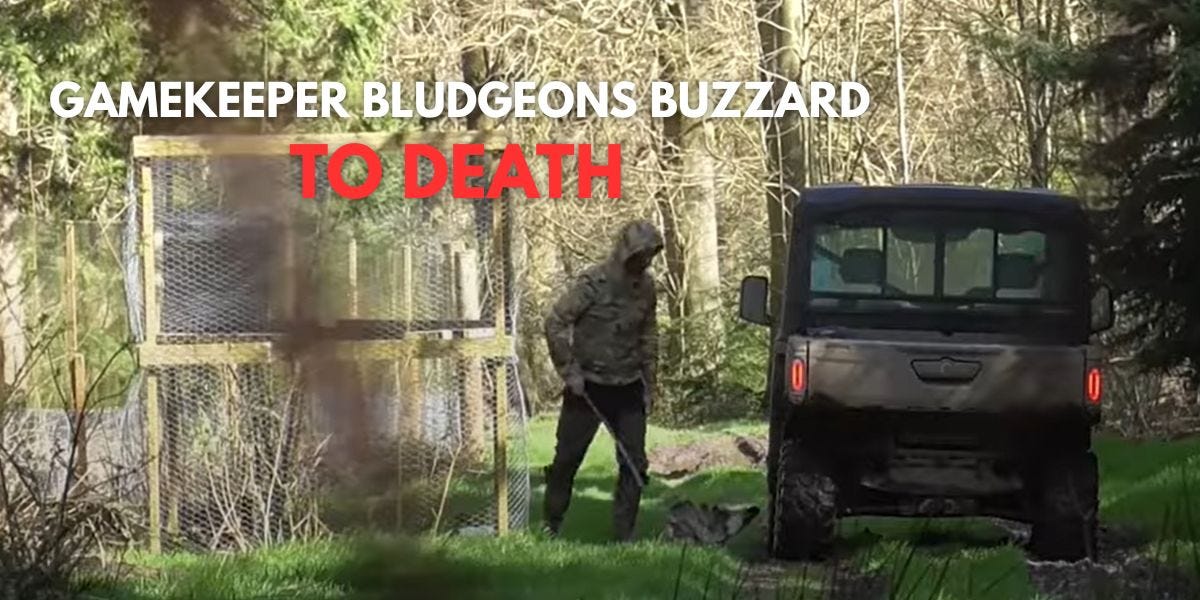
Back on 30 March 2024, a covertly deployed RSPB camera caught a gamekeeper beating a Buzzard to death inside a cage trap set in woodland on a pheasant shoot near Hovingham, North Yorkshire. Almost two years later, on 12 January 2026, Thomas Munday pleaded guilty at Scarborough Magistrates’ Court to killing a protected species. He was fined £1,215.
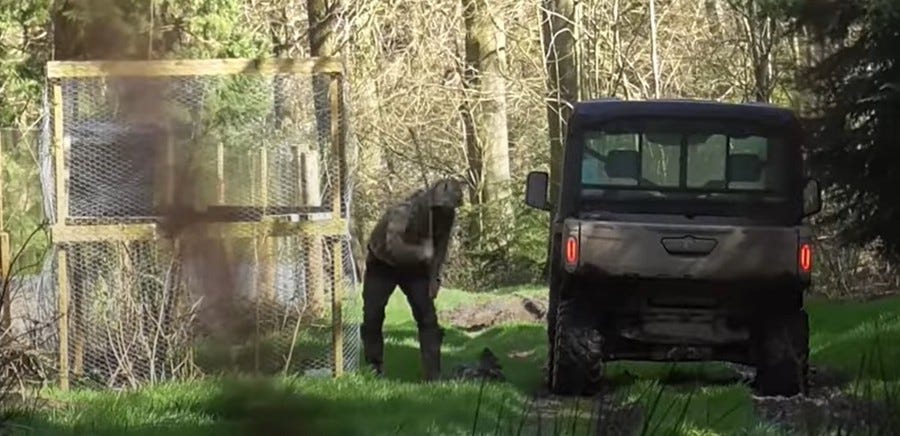
The RSPB states in their press release on the conviction that harrowing footage shows a Buzzard entering a crow cage trap. Four hours later, a masked and hooded individual arrives at the trap in an all-terrain vehicle. He enters the trap and is seen repeatedly striking the Buzzard with a stick. The injured and incapacitated Buzzard is then removed from the trap – clearly still alive – and beaten several more times with the same stick. The individual throws a pheasant corpse into the cage trap, then picks up the Buzzard by the wing and throws the bird into his vehicle before driving away from the site.
WARNING. It hardly needs saying, but the original footage is graphic and disturbing…
The RSPB shared the footage with North Yorkshire Police, who later identified the individual in the footage as gamekeeper Thomas Munday.
A police-led search of the land, assisted by the National Wildlife Crime Unit (NWCU), resulted in a number of items being seized, including the stick used to kill the Buzzard. Forensic testing by the Scottish Agricultural Science Agency (SASA) funded by the Partnership against Wildlife Crime (PAW) Forensic Analysis Fund found traces of Buzzard DNA on the stick.
Munday was subsequently charged with the illegal killing of the Buzzard, an offence under the Wildlife and Countryside Act 1981.
Wildlife crime and gamekeepers
Few people reading this will be surprised to learn that Munday was a gamekeeper. Gamekeepers are the shooting industry’s blunt tools. They are employed for one thing and one thing only: to kill wildlife so that other people can come and kill other wildlife. If committing wildlife crime appears to be part of that process, so be it…
The RSPB’s Howard Jones, Senior Investigations Officer, is quoted in the press release saying:
“The casual and brutal killing of the Buzzard is extremely upsetting to watch and it’s clear that Munday has a complete disregard for the law, and the legislation that protects these birds. Frustratingly, this incident isn’t a one-off but is just the latest example of the cruel and disturbing lengths some individuals will go to in order to illegally kill birds of prey.
“These crimes and the wider issue of bird of prey persecution is significantly linked to the gamebird shooting industry.”
Despite intensive lobbying by the shooting industry to convince us that gamekeepers are vital to the well-being of the countryside (the laughable National Gamekeepers’ Organisation writes that “Conservation work carried out by gamekeepers as part of game and shoot management plays a crucial role in preserving the habitats and wildlife so important to Britain’s biodiversity”), the facts are that of all individuals convicted of bird of prey persecution-related offences between 2009 to 2023, 75% were connected to the shooting industry and 68% were gamekeepers.
Between 2015 and 2024, thirty confirmed incidents of birds of prey being caught and/or dying in crow cage traps were recorded in the UK. 97% of these incidents were associated with land managed for bird shooting. 34 birds of prey were involved, with Buzzards, Goshawks and Sparrowhawks the most common victims.
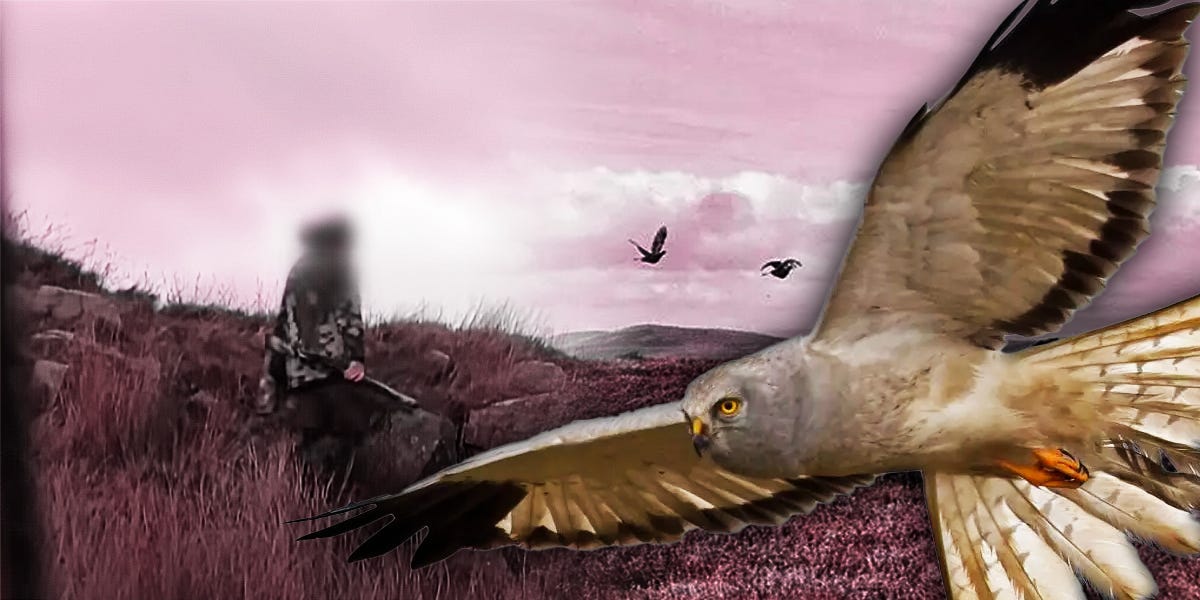
A culture of crime
The persecution of birds of prey is more than ‘significantly linked to the shooting industry’ though, it is driven and normalised by it.
Some landowners in the agricultural sector don’t like birds of prey either, but who else has such a historic and vested interest in ‘destroying the competition’? Not the public, hikers, birders, photographers, cyclists, or the vast majority of us. It is gamekeepers.
There is no ecological or environmental reason to kill birds of prey. It is not being done for conservation. It is being done to protect profit.
It was once legal for gamekeepers to eradicate birds of prey, and estates used to keep very detailed records of the eagles, hawks, and owls killed every year. But all raptor species have been fully protected by law for half a century. The old Victorian belief that anything with ‘hooked beak or claw’ must die is still clearly locked into the shooting mindset in far too many areas.
More than forty years after the passing of the Wildlife and Countryside Act, recent convictions prove the point:
Dorset gamekeeper Paul Scott Allen appeared before Weymouth Magistrates’ Court in January 2024 where he pleaded guilty to seven offences, including possession of a live or dead bird (or parts thereof) and misuse of a regulated poison.
Former gamekeeper (turned labourer, apparently) Alexander Hamilton was sentenced to a five-year ban from owning and keeping animals and was given 100 hours of community service at Edinburgh Sheriff Court on 05 March 2024 for causing unnecessary suffering to magpies.
In June 2023, Francis Addison, a part-time gamekeeper, pleaded guilty at Norwich Magistrates’ court to NINETEEN charges in connection with a multi-agency raptor persecution investigation led by Suffolk Police, including the possession of five shot Goshawks.
Gamekeeper Matthew Stroud appeared at Norwich Magistrates’ Court in October 2022 and admitted to the intentional killing of six Common Buzzards and a single Northern Goshawk (police found photos of the dead raptors, including the image above, on his mobile phone).
In July 2022 twenty-one-year-old Wiltshire gamekeeper Archie Watson was recorded dumping a dead bird of prey into a well on the shooting estate he worked on which was later found to contain the bodies of five dead buzzards and three Red Kites.
Scots gamekeeper Alan Wilson was convicted in 2019 of illegally killing dozens of animals – including shooting two Goshawks, four Common Buzzards, and a Peregrine falcon - on Longformacus Estate in the Scottish Borders.
Nine poisoned buzzards were found on Norfolk’s Stody shooting estate in 2014, killed by former gamekeeper Allen Lambert.
Why did Munday think he was above the law?
One of the most striking aspects of the footage (aside from its casual brutality, of course) is that Munday makes no attempt to hide what he is doing.
He is wearing a mask, but who other than an employee would be driving an ATV around a shooting estate? It’s obvious who it is, and that fact wasn’t disputed in court. He goes into the cage trap, beats the Buzzard, drags the still conscious bird out, and beats it again. He is not looking around. He doesn’t go into the trees. He is unhurried and utterly confident. It looks to us that he knows that the chances of being caught committing a crime on a private shoot where public access is limited or forbidden (as is the case on almost all shoots) is remote.
Might it also be true to suggest that even if he were seen killing the Buzzard, he is confident that no one from the shoot would do anything about it?
We’re not going to open ourselves to litigation by suggesting that any shoot operator would instruct their ‘keepers’ to go out and actively kill raptors, but there are some questions that we would like to see answered:
Who taught Thomas Munday to have “complete disregard for the law”, as the RSPB’s Howard Jones put it? He clearly wasn’t taught to respect it, so where did he get the idea that killing protected species is okay? His peers in the industry? His employers or their complicit clients? The idiots on online forums who complain there are ‘too many birds of prey’? All of them perhaps…
Why does he seem so casual and unconcerned about ‘being caught’? Does he know that anyone coming across him wouldn’t care what he was doing anyway?
Who will pay the £1,215 fine? Will it be Munday or will someone from within the shooting industry see it as ‘part of the cost of doing business’ and pay it for him?
What has Munday been doing since he was filmed in March 2024? Is he still out killing birds of prey? Is he still employed on the pheasant shoot? Will another shoot offer to employ a wildlife criminal who clearly shouldn’t be trusted around birds of prey (or corvids)?
Crows and Cage Traps
Little thought (if any at all) has been given to the corvid also seen trapped in the cage in the RSPB’s footage.
The crow is being used as a ‘call bird’ (a bait, in other words, to lure in other territorial crows). As Munday beats the Buzzard to death a few feet away, the crow is clearly terrified and tries to escape. How long he or she has been trapped, or the effect on a sentient bird of a human battering another bird in front of them, isn’t even discussed.
Most reports on this disgraceful crime have focused on the fact that the trap itself is lawful. Incredibly, crow cage traps can indeed be legally used under a licence issued by Defra and Natural England. General Licences don’t need to be applied for. No knowledge has to be displayed to earn one. They are issued “on condition” that licence conditions will be adhered to. Munday wasn’t remotely interested in such a legal nuance - nor was he concerned in the slightest about the corvid exploited in the trap either.
The law says that if a bird of prey or any other non-target species is caught in the trap, on discovery the bird must be released at point of capture without undue delay. Again, something Munday is not concerned about. But what about the crow? These are remarkable birds, ranking among the smartest of animals, with problem-solving, tool-making, and planning skills comparable to young children (around 7 years old). They can demonstrate abilities like facial recognition, memory, and social learning.
Crows caught in cage traps experience immense stress, fear, and potential injury in confinement; legally, they should (in the jargon) be ‘dispatched humanely’ by the cage operator, but they often die from starvation, dehydration, predation, or exposure. And what is the usual method of ‘humane dispatch’ of the survivors? Gamekeepers use a stick or a specialized tool called a "priest" and beat them to death…just like the Buzzard was beaten to death in the video.

Licencing is NOT the answer
As far as the shooting industry is concerned, it is perfectly acceptable to trap corvids during the breeding season, and keep them where they are vulnerable to attack. It is normal to beat them to death with a stick. Crows are seen as instruments, not sentient beings.
This is an important point. We are hugely supportive of the RSPB Investigations Team. They are incredibly dedicated professionals. But we do fundamentally disagree with the RSPB’s insistence that cases like this somehow reinforce the need for ‘licencing of shooting’.
In its press release, James Robinson, RSPB Chief Operating Officer, is quoted saying:
“Through the introduction of a robust licensing system for all gamebird shooting across the UK, the illegal killing of birds of prey could be effectively deterred. Scotland took this welcome step in 2024 when it introduced licensing for grouse shooting. We need the Government to take action, now.”
Apart from the fact that killing birds of prey is already unlawful (and how concerned did Munday appear as he smashed in the head of the Buzzard? Would a licence really make any difference?), how would licencing help corvids caged in traps? Not at all.
And how would licencing help the millions of pheasants and partridges factory farmed in appalling conditions across the UK and blasted out of the air every year on shooting estates? Or the unknown numbers of mammals snared, trapped, poisoned, and bludgeoned to death by gamekeepers every year? Not at all.
The shooting industry operates behind closed doors - whether that’s on the disgusting farms they use to produce birds for the gun, or in the woods and moors where they sell those birds to their clients. Licencing won’t throw those doors open. Employees like Munday will still feel like they can get away with it. And millions of birds will still die.
Licencing is not the answer. It is shutting down this bloody industry once and for all.

Our Undercover Investigation: perhaps the largest and most widespread investigation into the breeding and rearing of birds for shooting ever documented.
We’ve now compiled over 100 pages of notes, captured more than two hundred screenshots, and have outlined at least thirty ‘stories’ we intend to tell.
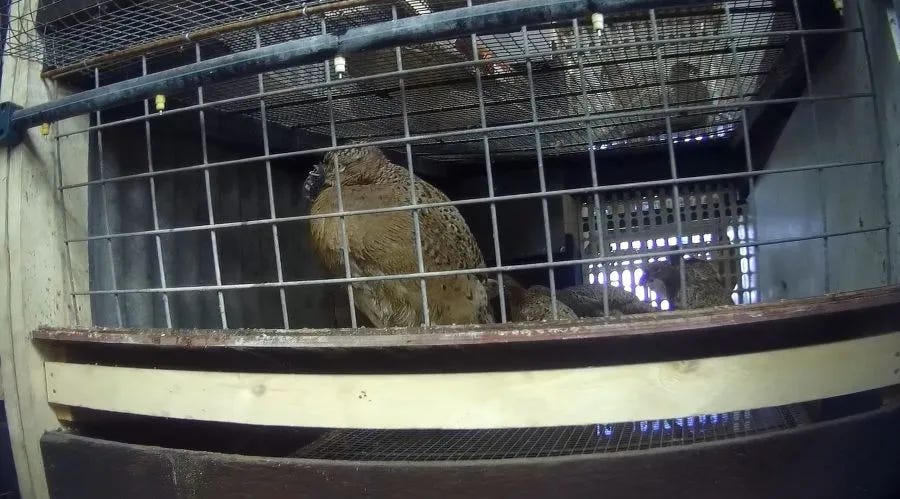
Pheasant and partridge farms are intensive, industrial-scale factory farms where birds are treated appallingly badly. There is a built-in ‘redundancy’ where owners accept bird deaths as ‘par for the course’, and routine disregard for the industry’s own Codes of Practice.
The shooting industry likes to portray itself as a high-standard, high-skilled producer of wild birds for the gun. We will prove that this is patently untrue.
Coming very soon…
These psychopaths will continue their evil while shooting estates exist.
disgusting - the RSPB should also set up cameras on its patron's estates (Big Ears)